Beekeeping
Bush Bees Home
Comb Honey
Expense of Making Wax
Crush and Strain
Double Bucket Strainer
Removing Bees for Harvesting
Abandonment
Brushing and Shaking
Bee Escapes
Blowing
Butyric
Fischer Bee Quick
Click on Thumbnails for bigger pictures
Books for sale
Speaking
Be a patron on Locals
My YouTube Channel
Donations
Beekeeping Apprentice needed
Beekeeping Equipment
Beekeeping Carts
Beekeeping Things I Did Not Invent
Foundationless Beekeeping
Hardware Cloth Uses in Beekeeping
Hive Box Jig
Horizontal Hive Beekeeping
Lighter Beekeeping Equipment
Miscellaneous Beekeeping Equipment
Narrow Frame Beekeeping
Nucleus Hives
Observation Hives
Top Bar Hive Beekeeping
Top Entrance
Two Queen Hive
Wax Dipping Hives
Beekeeping Information
Beekeeping Acronym Glossary
Beekeeping Basics
Beekeeping Fallacies
Beekeeping Math
Beekeeping Locality
Beekeeping Systems
Beekeeping Terminology
Beginner Beekeepers
Classic Beekeeping Books
Colony Decisions
Contrary Opinions
Differences in Observations on Beekeeping
Experiment in Swarm Control
Feeding Bees
Frequently Asked Beekeeping Questions
Forums, how to get a good response
Harvesting Honey
Health Certificates since 2004
Inspections
Installing Packages
Laying Workers
Lazy Beekeeping
Mites that live on bees
More Than Just Bees
Moving Bees
Organic Beekeeping Meetings
Panacea
Presentations
Realistic Expectations in Beekeeping
Robbing
Smoke
Space Management
Splits
Spring Beekeeping Management
Swarm Control
Ten Commandments of Beekeeping
Timing
Too Many Beekeeping Options?
Unlimited Broodnest
Unnatural Things in Beekeeping
Videos of some of my presentations
Water
Wintering Bees
Bee Pests
CCD
Enemies of Beekeeping
Four Simple Steps to Healthier Bees
Mite Bombs
Natural Cell Size
Nosema
Rationalizations on small cell success
Varroa Treatments
Wax Moths
Why I Use No Treatments of Any Kind
Queens
A Few Good Queens
Feral Bees
Genetic Diversity
Quality of Emergency Queens
Queen Flying Off
Queen Rearing
Queen Spotting
Queens For Sale
Races of Bees
Requeening a hot hive
Whole bee concept
Philosophy
Beekeeping Philosophy
Belief in Beekeeping
The Hardest Thing To Do In Beekeeping
How bees change your life
Learning
Native American Honey Bees
Scientific Studies
Other Links
Beesource Beekeeping Forum
Beesource Beekeeping Home
Beemaster Beekeeping Home Page
Dee Lusby on Small Cell Beekeeping
Bee Unto Others
Dave Cushman
Resistant Bees
Beekeeper Linda
Beekeeping like a girl
Bella Donna, Apitherapist
english, español, deutsche, português, français, русском, română, polsku, беларускай,
Honey Harvest

Comb Honey
Normally I'm not shy about saying things my own way, but Richard Taylor said this so well, I will not even attempt to do better. For more of his wisdom check out "The Comb Honey Book".
Richard Taylor on Comb Honey:
"A comb honey beekeeper really needs, in addition to his bees and the usual apiary equipment and tools, only one other thing, and that is a pocket knife. The day you go into producing extracted honey, on the other hand, you must begin to think not only of an extractor, which is a costly machine used only a relatively minute part of the year, but also of uncapping equipment, strainers, settling tanks, wax melters, bottle filling equipment, pails and utensils galore and endless things. Besides this you must have a place to store supers of combs, subject to damage by moths and rodents and, given the nature of beeswax, very subject to destruction by fire. And still more: You must begin to think in terms of a whole new building, namely, a honey house, suitably constructed, supplied with power, and equipped....
"All this seems obvious enough, and yet time after time I have seen novice beekeepers, as soon as they had built their apiaries up to a half dozen or so hives, begin to look around for an extractor. It is as if one were to establish a small garden by the kitchen door, and then at once begin looking for a tractor to till it with. Unless then, you have, or plan eventually to have, perhaps fifty or more colonies of bees, you should try to resist looking in bee catalogs at the extractors and other enchanting and tempting tools that are offered and instead look with renewed fondness at your little pocket knife, so symbolic of the simplicity that is the mark of every truly good life."
Expense of making wax
Richard Taylor on the expense of making wax:
"The opinion of experts once was that the production of beeswax in a colony required great quantities of nectar which, since it was turned into wax, would never be turned into honey. Until quite recently it was thought that bees could store seven pounds of honey for every pound of beeswax that they needed to manufacture for the construction of their combs--a figure which seems never to have been given any scientific basis, and which is in any case quite certainly wrong. The widespread view that if the combs were used over and over, through the use of the honey extractor, then the bees would be saved the trouble of building them and could convert the nectar thus saved into honey, was only minimally correct. A strong colony of bees will make almost as much comb honey as extracted honey on a strong honey flow. The advantage of the extractor, in increasing harvests, is that honey stored from minor flows, or gathered by the bees over many weeks of the summer, can easily be extracted, but comb honey cannot be easily produced under those conditions."--Richard Taylor, The Comb Honey Book
Doolittle's opinion:
"Again, at all times of a heavy yield of honey, the bees secrete wax whether any combs are built or not; and if the sections are all supplied with foundation, and the hive filled with comb, this wax is wasted or else the foundation given is wasted; have it which way you please...To show that I am not alone in this matter regarding the waste of wax, I wish to quote from two or three of our best apiarists; the first is Prof. Cook, and no one will say that he is not good authority. he says on page 166 of the latest edition of his Manual 'But I find upon examination that the bees, even the most aged, while gathering, in the honey season, yield up the wax scales the same as those within the hive. During the active storing of the past season, especially when comb-building was in rapid progress, I found that nearly every bee taken from the flowers contained wax scales of varying size, in the wax pockets.'
"This is my experience during "active storing," and the wax scales are to be found on the bees just the same whether they are furnished with foundation or not; and I can arrive at no other conclusion than that arrived at by Mr. S.J. Youngman, when he says on page 108: 'The bees secrete wax during a honey flow, whether they are building comb or not; and if they are not employed in building comb, this wax is most certainly lost.'
"Once more on page 93, of the American Apiculturist, Mr. G.W. Demaree says: 'Observation has convinced me that swarms leave the parent colony better prepared to build comb than they ever are under other circumstances; and that if they are not allowed to utilize this accumulated force, by reason of having full sheets of foundation at hand to work out, there will necessarily be some loss; and I think that when the matter is computed, to find the loss and gain the result will show that the foundation really costs the apiarist double what he actually pays for it in cash'...Now, I have often noticed, and especially in looking back over the last year, after reading Mr. Mitchell's "Mistaken Economy," that swarms hived in June would fill their hives full of nice straight worker combs, and the combs would be filled with brood during the first two weeks after hiving; while a colony not casting a swarm would not make a gain of a single pound of honey; nor would a swarm having a full set of combs given them, or the frames filled with foundation, be a whit better off at the end of two weeks. Mr. P.H. Elwood has noted the same thing; thus proving that the theory that it takes 20 pounds of honey to produce one pound of comb, will not hold good in cases where bees desire comb and have free access to pollen. As most of my comb is built at this time, the reader will readily see that the combs cost me but little, save the looking after the colony once or twice while building comb, which is far cheaper than buying foundation, or fussing with a foundation mill."--G.M. Doolittle ABJ Vol 20 No 18 pg 276
From Beeswax Production, Harvesting, Processing and Products, Coggshall and Morse pg 35
"Their degree of efficiency in wax production, that is how many pounds of honey or sugar syrup are required to produce one pound of wax, is not clear. It is difficult to demonstrate this experimentally because so many variables exist. The experiment most frequently cited is that by Whitcomb (1946). He fed four colonies a thin, dark, strong honey that he called unmarketable. The only fault that might be found with the test was that the bees had free flight, which was probably necessary so they could void fecal matter; it was stated that no honey flow was in progress. The production of a pound of beeswax required a mean of 8.4 pounds of honey (range 6.66 to 8.80). Whitcomb found a tendency for wax production to become more efficient as time progressed. This also emphasizes that a project intended to determine the ratio of sugar to wax, or one designed to produce wax from a cheap source of sugar, requires time for wax glands to develop and perhaps for bees to fall into the routine of both wax secretion and comb production."
The problem with most of the estimates on what it takes to make a pound of wax is they don't take into account how much honey that pound of wax will support
From Beeswax Production, Harvesting, Processing and Products, Coggshall and Morse pg 41
"A pound (0.4536 kg.) of beeswax, when made into comb, will hold 22 pounds (10 kg.) of honey. In an unsupported comb the stress on the topmost cells is the greatest; a comb one foot (30 cm.) deep supports 1320 times its own weight in honey."
Crush and Strain
I kept bees for 26 years without an extractor. I made cut comb honey and I did crush and strain to get liquid honey. When I finally did buy one I got a motorized radial 9/18.
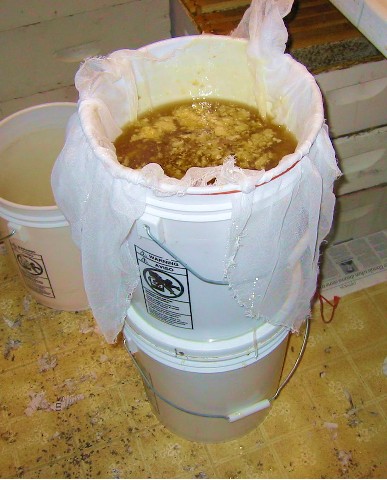
The method I arrived at to crush and strain, is a double bucket strainer. I use these even when I'm extracting because they hold so much honey and it's the only way I can keep up with straining as I go. Also, I can put the cappings in to strain. But before I got an extractor this was how I did it.
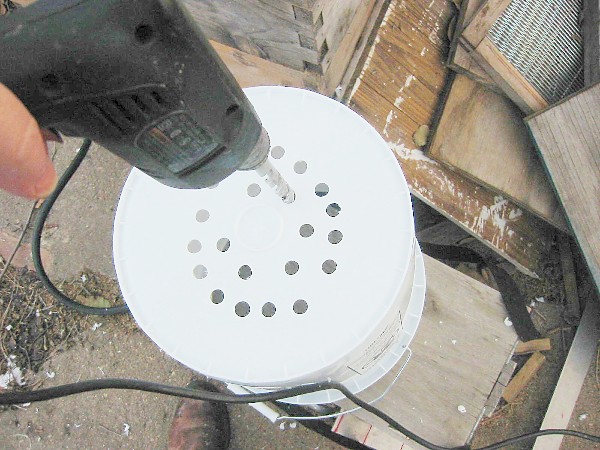
On the left, making the top bucket for the double bucket strainer. Drill the holes. If you make the holes small enough you can just use the bottom of the bucket for the strainer with no other strainer or screen. You can skim the wax off the top and leave whatever settles on the bottom. Cut the middle out of a lid (leaving an inch rim for the top bucket to rest on).
On the right, using the double bucket strainer to strain honey.
Removing bees for harvesting.
This is always a topic rife with disagreement. A lot of this is due to personal experience. Timing of these methods changes the outcomes tremendously.
Abandonment
C.C. Miller's favorite method is usually called "abandonment". This is where you pull each box off the hive and set it on its end so the top and bottom are exposed. This is best done at the end of the flow but not during a dearth and just after sunset but before dark. The bees tend to wander back to the hive and you can take the supers. If there is brood in them, they will not leave. If there is a dearth you will set off a robbing frenzy. If you do it in the middle of the afternoon this will be harder to deal with. This requires handling the boxes twice. Once to take them off and once to load them up. (I'm not counting the rest of the process)
Brushing and/or shaking
Some people just pull each frame, shake or brush off the bees and put the frame in a different box with a cover. This puts many bees in the air and is a bit intimidating and is tedious. You move every box a frame at a time and then you load the boxes a box at a time.
Bee Escapes
There are several kinds and the results may vary based on the kind. I never had any luck with the Porter escapes that go in the hole on the inner cover. But I have liked the triangular ones from Brushy Mt. Usually the supers are removed, the escape is put on (it's one way so be sure its the right way, letting the bees out, but not in) and you wait a day or two for the bees to leave. Again, they will not leave if there is brood in the supers. I prefer to put one of these on a bottom board (with the escape down) and stack supers up about as high as I can reach them and then put one on top (with the escape up) and come back in 24 to 48 hours. The biggest disadvantage is you have to handle every box three times if you put it on the hive (once to get them off, then put on the escape, then stack them back on the hive, then load them up) and twice if you put it on its own bottom board (once to stack them on the bottom board and once to load them up).
Blowing
The concept is to just blow all the bees off the combs. Some people use a leaf blower and some buy a bee blower. One argument against is that anything strong enough to blow the bees off will rip many of them in half. I've never used it so I can't say.
Butyric
I listed this separate from Bee Quick although they have some things in common, I don't consider them even in the same ballpark. Both are bee repellents that are used to drive the bees from the supers. Bee Go and Honey Robber are Butyric which is not a food safe chemical and smells like vomit. Honey robber smells like cherry flavored vomit. The chemical is put on a fume board, which is put on top of the hive. The bees are driven down and the supers are pulled off and loaded. They are only handled once. I have smelled it. I have never used it.
Fischer Bee Quick
Jim doesn't want to give away his trade secrets so he won't say what's in this. But is smells like benzaldehyde to me. Benzaldehyde is the smell of Maraschino cherries. After making benzaldehyde in my organic chem. class, I've never been able to eat a Maraschino cherry again. It's also the main ingredient in artificial almond flavoring. But Jim Fischer assures us this is nothing but food grade essential oils. It certainly smells better and, by all accounts, is much safer than butyric. Otherwise it works on the same principle. You put it on a fume board on top and drive the bees down. The supers only have to be handled once to load them. I have smelled it and it smells fine, but I have never used it.
Michael Bush
Copyright 2006/2007 by Michael Bush