Beekeeping
Bush Bees Home
Why go foundationless?
How do you go foundationless?
Foundationless frames
Historic references
Frequently asked questions about foundationless beekeeping
You mean I can just put a box of empty frames on the hive?
What is a comb guide?
Which comb guide do you like best?
Can I extract them?
Do I need wire in them?
Can I use wire in them?
Can I put a whole box of foundationless frames on a hive?
Won't the bees mess it up without foundation?
Won't it set the bees back having to build their own comb?
Is it a good idea for a beginner to use foundationless?
What if they mess it all up?
Won't they just build drone comb?
Click on Thumbnails for bigger pictures
Books for sale
Speaking
Be a patron on Locals
My YouTube Channel
Donations
Beekeeping Apprentice needed
Beekeeping Equipment
Beekeeping Carts
Beekeeping Things I Did Not Invent
Foundationless Beekeeping
Hardware Cloth Uses in Beekeeping
Hive Box Jig
Horizontal Hive Beekeeping
Lighter Beekeeping Equipment
Miscellaneous Beekeeping Equipment
Narrow Frame Beekeeping
Nucleus Hives
Observation Hives
Top Bar Hive Beekeeping
Top Entrance
Two Queen Hive
Wax Dipping Hives
Beekeeping Information
Beekeeping Acronym Glossary
Beekeeping Basics
Beekeeping Fallacies
Beekeeping Math
Beekeeping Locality
Beekeeping Systems
Beekeeping Terminology
Beginner Beekeepers
Classic Beekeeping Books
Colony Decisions
Contrary Opinions
Differences in Observations on Beekeeping
Experiment in Swarm Control
Feeding Bees
Frequently Asked Beekeeping Questions
Forums, how to get a good response
Harvesting Honey
Health Certificates since 2004
Inspections
Installing Packages
Laying Workers
Lazy Beekeeping
Mites that live on bees
More Than Just Bees
Moving Bees
Organic Beekeeping Meetings
Panacea
Presentations
Realistic Expectations in Beekeeping
Robbing
Smoke
Space Management
Splits
Spring Beekeeping Management
Swarm Control
Ten Commandments of Beekeeping
Timing
Too Many Beekeeping Options?
Unlimited Broodnest
Unnatural Things in Beekeeping
Videos of some of my presentations
Water
Wintering Bees
Bee Pests
CCD
Enemies of Beekeeping
Four Simple Steps to Healthier Bees
Mite Bombs
Natural Cell Size
Nosema
Rationalizations on small cell success
Varroa Treatments
Wax Moths
Why I Use No Treatments of Any Kind
Queens
A Few Good Queens
Feral Bees
Genetic Diversity
Quality of Emergency Queens
Queen Flying Off
Queen Rearing
Queen Spotting
Queens For Sale
Races of Bees
Requeening a hot hive
Whole bee concept
Philosophy
Beekeeping Philosophy
Belief in Beekeeping
The Hardest Thing To Do In Beekeeping
How bees change your life
Learning
Native American Honey Bees
Scientific Studies
Other Links
Beesource Beekeeping Forum
Beesource Beekeeping Home
Beemaster Beekeeping Home Page
Dee Lusby on Small Cell Beekeeping
Bee Unto Others
Dave Cushman
Resistant Bees
Beekeeper Linda
Beekeeping like a girl
Bella Donna, Apitherapist
english, español, deutsche, português, русском, română, polsku, беларускай,
Foundationless

Why would one want to go foundationless?
How about no chemical contamination of the combs and natural Varroa control from natural cell size? As far as contamination, some of my queens are three years old and laying well. I don't think you'll find anyone who is using chemicals in their hives with that kind of longevity and health in their queens. You can also get clean wax combs with natural cells in a top bar hive.
How do you go foundationless?
Bees need some kind of guide to get them to draw straight comb. Any beekeeper has seen them skip the foundation and build combs between or out from the face of the comb, so we know that sometimes they ignore those clues. But a simple clue like a beveled top bar or a strip of wax or wood or even a drawn comb on each side of an empty frame will work most of the time. You can just break out the wedge on a top bar, turn it sideways and glue and nail it on to make a guide. Or put Popsicle sticks or paint sticks in the groove. Or just cut out the old comb in a drawn wax comb and leave a row at the top or all the way around. The main thing is that there is an edge that protrudes, preferably at least 1/4". Waxing wood guides is not only not necessary but I don't recommend it. The wax you put on won't be attached as well as the bees will attach it.
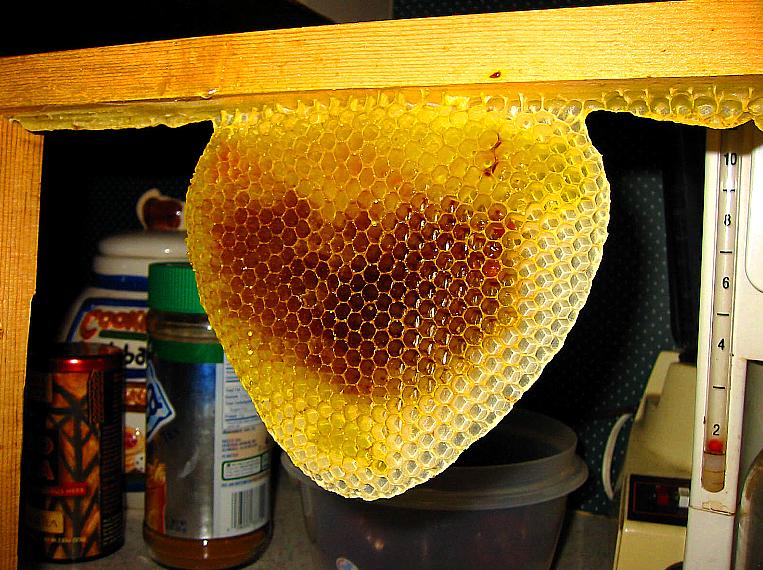
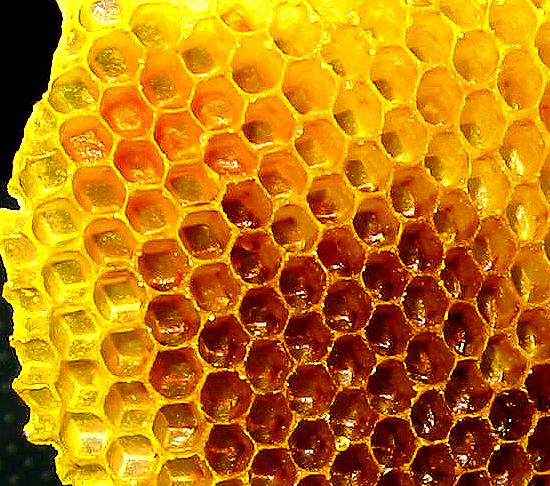
Comb started on a blank starter strip. This natural comb was brood and was drawn by regular Carniolans that were already regressed. The cells are 4.6mm. The frames were spaced on 1 1/4" (32mm) centers. One can also use strips cut from foundation
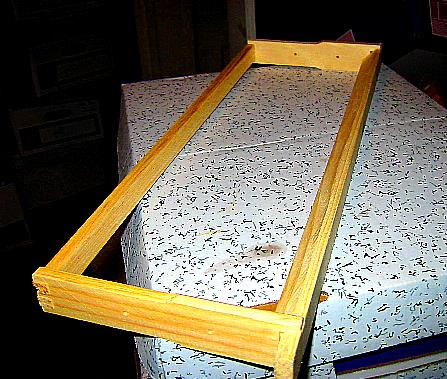
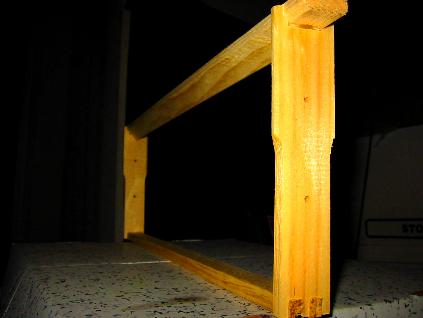
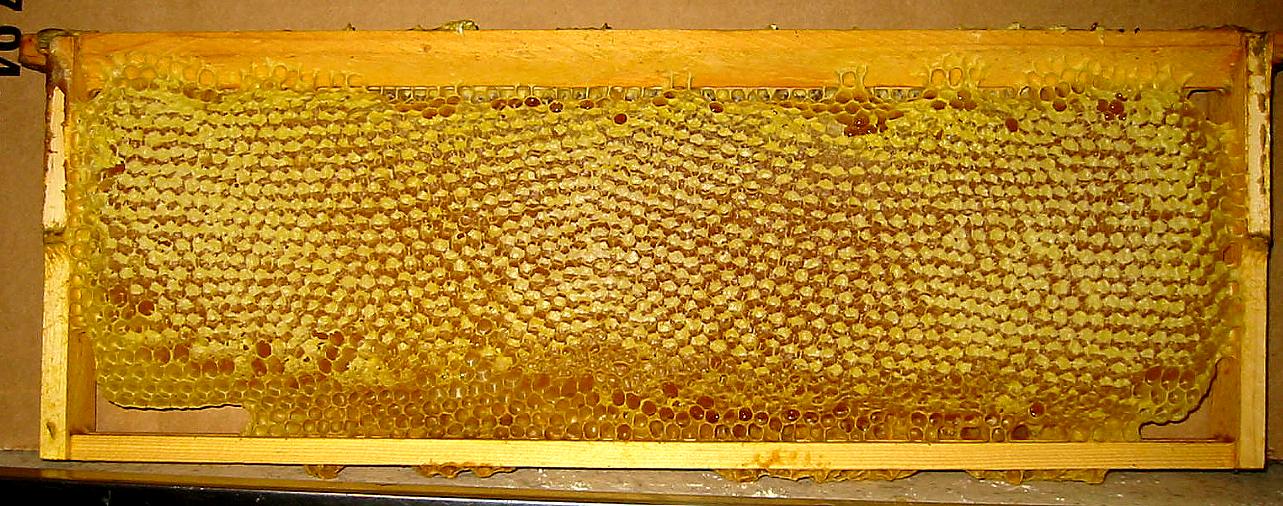


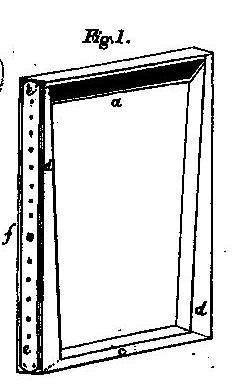

Foundationless frames
I made these by ordering frames from Walter T. Kelley with no grooves in the top and bottom bars and cutting the top bars at a 45 degree angle on both sides. The bees tend to follow the sloped top bar. L.L. Langstroth has pictures of this design in the original "Langstroth's Hive and the Honey Bee" which you can still buy as a reprint.
3rd from the left, drawn foundationless frame. Note the corners are often open, the bottom seems to be the last to get attached, but this is attached on all four sides and ready to be uncapped and extracted.
4th from left, here is a Dadant Deep foundationless with a comb guide all the way around and a 1/16" (1.6mm) steel rod for support horizontally in the center. This allows cutting six pieces of 4" by 4" comb honey out without fighting with wires. Langstroth also used the comb guides on the side like this.
Last three. Page from LL. Langstroth's Hive and the Honey Bee and close ups of the original foundationless frames and the "comb guide."
In my experience the bees will draw their own comb faster than they will draw foundation. I'm not the only one to make the observation that bees are not attracted to foundation.
"Foundation, even composed of pure beeswax, is not intrinsically attractive to bees. Swarming bees offered the opportunity to cluster on foundation or some branch, show no preference for foundation." --The How-To-Do-It book of Beekeeping, Richard Taylor
"...swarms hived in June would fill their hives full of nice straight worker combs, and the combs would be filled with brood during the first two weeks after hiving...nor would a swarm having a full set of combs given them, or the frames filled with foundation, be a whit better off at the end of two weeks. Mr. P.H. Elwood has noted the same thing; thus proving that the theory that it takes 20 pounds of honey to produce one pound of comb, will not hold good in cases where bees desire comb..."--G.M. Doolittle ABJ Vol 20 No 18 pg 276
"...yet foundation is far from being a success, when compared with natural worker comb. In the first place it has sagged badly, unless built out in cool weather, and even in cool weather it sags so that the cells in the upper part of the combs measures 4 1/2 cells to the inch (5.6mm), while natural comb for brood purposes measures 5 (5.08mm); also some of this built out in cool weather, when filled with honey and sealed over, sagged so as to tear the cells apart and set the honey to running, with the mercury at 90 degrees in the shade, while not a natural comb stirred a particle. In the second place, it requires twice as much fussing and looking after, to get it built out into half-way decent combs, that it takes to get natural comb built; and thirdly, it costs more than natural comb, where you have to pay more than 50 cents per lb... I have said nothing of its use for comb honey, as I have discarded it from the boxes altogether, for the reasons that when honey is plenty and the bees are secreting wax, they simply add their wax to the foundation, never touching it to draw it out a particle. By scraping the wax off we have the foundation just as it was given to them, and nobody likes to eat such stuff. My advice would be, discard it from the boxes altogether"--G.M. Doolittle, ABJ Vol 15 No 1 pg 11
Historic References
Most of these can be found online in Cornell's Hive and the Honey Bee collection.
"HOW TO SECURE STRAIGHT COMBS. "The full advantages of the movable comb principle is only secured by getting all the combs built true within the frames. Upon the first introduction of movable frames, bee-keepers frequently failed in this although much care and attention were given. Mr. Langstroth, for a time, used for guides strips of comb attached to the under side of the top bar of the frame. This is a very good practice when the comb can be had, as it usually secures the object besides giving the bees a start with worker comb. Next followed the triangular comb guide consisting of a triangular piece of wood tacked to the under side of the top bar, leaving a sharp corner projecting downwards. This is a valuable aid and is now universally adopted." --FACTS IN BEE KEEPING by N.H. and H.A. King 1864, pg. 97
"If some of the full frames are moved, and empty ones placed between them, as soon as the bees begin to build powerfully, there need be no guide combs on the empty frames, and still the work will be executed with the most beautiful regularity." --The Hive and the Honeybee by Rev. L.L. Langstroth 1853, pg. 227
"Improved Comb Bar.--Mr. Woodbury says that this little contrivance has proved very effectual in securing straight combs when guide combs are not obtainable. The lower angles are rounded off whilst a central rib is added of about 1/8 of an inch (3mm) in breadth and depth. This central rib extends to within 1/2 an inch (13mm) of each end, where it is removed in order to admit of the bar fitting into the usual notch. All that is necessary to insure the regular formation of combs is, to coat the underneath surface of the central rib with melted wax. Mr. Woodbury further says, "my practice is to use plain bars, whenever guide-combs are attainable, as these can be attached with much greater facility to a plain than to a ribbed bar; but whenever I put in a bar without comb, I always use one of the improved ones. By this method , crooked and irregular combs are altogether unknown in my apiary." Most of our bars are made with the ridge; but should any of our customers prefer the flat ones, we keep a few to supply their requirements"--Alfred Neighbour, The apiary, or, Bees, bee hives, and bee culture pg 39
"Top bars have been made by some hive manufacturers from one-fourth-inch (6mm) to three-eights-inch (9.5mm) strips, strengthened somewhat by a very thin strip placed edgewise on the underside as a comb guide; but such bars are much too light and will sag when filled with honey or with brood and honey..."--Frank Benton, The honey bee: a manual of instruction in apiculture pg 42
"Comb Guide.--Generally a wooden edge, or a strip of comb or fdn., in the top of a frame or box, on which comb is to be built...As the comb guide is 9-16 (14mm), and the cut in the end bar 3/4 (19mm), we have 3-16 (4.8mm) left for whole wood in the top bar, as at A, and the table should be set, as to leave just this amount of wood uncut. Even if the fdn. is fastened in the frames with melted wax as many do, I would have such a comb guide, because it adds so much to the strength of the frame, and obviates the necessity of having a very heavy top bar. The bees will, in time, build their combs right over such a comb guide, and use the cells above the brood for honey."-- A.I. Root, ABC of Bee Culture 1879 edition pg 251
"A comb guide proper is a sharp edge or corner in the frame, from which the comb is to depend, the bees usually choosing to follow this edge, rather than diverge to an even surface; portions of comb are sometimes used for the same purpose."--J.S. Harbison, The bee-keeper's directory, footnote at the bottom of page 280 and 281
Foundationless Beekeeping Frequently Asked Questions:
You mean I can just put a box of empty frames on the hive?
Answer:
No. The bees need some kind of guide.
What is a comb guide?
Answer:
It can be any of several things. You can use an empty frame with nothing added if you have a drawn brood comb on each side as the brood comb will act as a guide. You can put popsicle sticks in the groove to make a sort of wooden strip, or cut a piece of wood to make a wood starter strip. You can turn the wedge on end and glue it in. You can cut a triangular piece and put on the bottom of the top bar. You can buy chamfer molding and cut it to fit and put it on the bottom of the top bar. You can cut the top bars on a bevel. You can make a sheet of empty wax and cut it into 3/4" (19mm) wide strips and put in the groove of the top bar and wax it in. You can cut strips of regular foundation into 3/4" (19mm) wide strips and wax that in the groove or nail it with the cleat. If the frame already had comb in it, you can just leave the top row of cells on the top bar for a guide. Any of these work fine.
Which comb guide do you like best?
Answer:
I'll start with what I like the least. A wax bead in a groove is almost no guide at all. In order to be effective a guide needs to protrude at least 1/4" (6mm). Other than that I like all of them fine, but I like the durability of the beveled top bar and I think the comb is attached a bit better. Next I'd probably go for the wood strip. Last I'd go for the starter strips as they sometimes get hot and fall out if the bees haven't used them yet. But I also feed empty frames into brood nests all the time as I have a lot of old frames around. Bottom line is, I do whatever is the easiest at the time.
Can I extract them?
Answer:
Yes. I extract them all the time. Just make sure they are attached on all four sides and the wax isn't so new that it's still soft, like putty. Once the wax is mature and the comb is attached at least some on all four sides, it extracts fine. Of course you should always be gentle with any wax combs (wired or not) when extracting.
Do I need wire in them?
Answer:
I don't use wire but I don't use deeps either.
CAN I use wire in them?
Answer:
Sure. The bees will incorporate the wire into the comb. Of course you need the hive level anyway, but this becomes more obvious with wire in the comb. Wire is probably more useful when doing deeps than mediums. I run all mediums.
Can I put a whole box of foundationless frames on a hive?
Answer:
Assuming we mean frames with comb guides, yes, you can. Usually this works fine. Sometimes because of a lack of a comb to use as a "ladder" to get up to the top bars, the bees start building comb up from the bottom bar. For this reason I prefer to have one frame of drawn comb or a full sheet of foundation in a super being added on. This isn't a problem when installing a package. Another reason for the one comb, though, is it's good insurance at getting the combs in the right direction. Another solution to them trying to build comb up, is to put the empty box under the current box so they can work down.
Won't the bees mess it up without foundation?
Answer:
Sometimes. But they mess it up sometimes even with wax and even more often with plastic. I've seen no more bad combs doing foundationless than I have using plastic foundation. Some of this appears to be genetic as some hives build good comb even when you do everything wrong. Other hives build messed up comb even when you do everything right and simply repeat the "mistakes" when you remove them.
The most important thing to grasp with any natural comb hive is that one good comb leads to another in the same way that one bad comb leads to another. You cannot afford to not be paying attention to how they start off. The most common cause of a mess of comb is leaving the queen cage in as they always start the first comb from that and then the mess begins. I can't believe how many people want to "play it safe" and hang the queen cage. They obviously can't grasp that it is almost a guarantee of failure to get the first comb started right, which without intervention is guaranteed to mean every comb in the hive will be messed up. Once you have a mess the most important thing is to make sure the last comb is straight as this is always the guide for the next comb. You can't take a "hopeful" view that the bees will get back on track. They will not. You have to put them back on track.
This has nothing to do with wires or no wires. Nothing to do with frames or no frames. It has to do with the last comb being straight.
Won't it set the bees back having to build their own comb?
Answer:
In my experience, and many others who have tried it as well, the bees build their own comb much more quickly than they build on foundation. Using foundation sets them back in many ways. First they draw foundation more slowly. Second, the foundation is all contaminated with fluvalinate and coumaphos. Third, unless you're using small cell foundation, you're giving them cells that are larger than they want and giving the advantage to the Varroa. In the earlier G.M. Doolittle quote he makes it clear he believes there is no advantage in this regard to using foundation.
Is it a good idea for a beginner to use foundationless?
Answer:
In my opinion it's easier for the beginner who has no habits to adjust to foundationless. It's much more difficult for the seasoned beekeeper to adjust to keeping hives perfectly level, not turning comb flatways, not shaking bees vigorously off of a comb that's still new and not well attached etc. Beginners will often break one comb and learn their lesson. Experienced beekeepers will keep falling back into habits and breaking combs for a while until they finally get it ingrained as a new habit.
This necessity of handling new combs differently is not unique to foundationless.
"Beginners should be careful when turning a new comb heavy with honey on a warm day, or it might fall out of the frame. If, when holding such a frame breast high, the left hand is lowered and the frame swung round at same time, the other side of the comb will be brought into view upside down, without having put the slightest strain on it. By reversing the process, the comb is brought back to its original position."--Isaac Hopkins, The Autralasian Bee Manual
Hopkins was talking about combs using wax foundation. Foundationless increases the likelyhood.
What if they mess it all up?
Answer:
It's doubtful but possible that they will. I've seen this occur more often when a box full of frames with wax foundation collapses in the heat. I suppose this seems much more frightening to someone who has never done a cutout. If you've ever cut all the combs out of a wild hive and tied them into frames, then you already know what to do. You cut the wild combs and you put them in an empty frame and use rubber bands or string to hold them in the frame. The bees will take care of the rest. They do this just as often with plastic foundation and it's often more difficult to fix.
If I make my own what dimensions should they be?
Answer:
You can make them out of standard frames, but I do prefer them with smaller end bars and slightly smaller top bars. See the frame width page.
Won’t they just build drone comb?
Answer:
Only the first frame or two. Bees have a threshold for drones that varies depending on resources and time of year. They will go to a lot of effort to reach that threshold.
Drones get a bad rap. They are accused of being lazy. They leave the hive every afternoon and fly until they are exhausted. Their lives are just as short because they work just as hard as the foragers. The only downside for the hive is that they don't produce honey, but they do work at perpetuating the species at great cost to themselves, even if they don't succeed and greater if they do.
This study says they also help heat brood: Thermal investigations of a honey bee colony: thermoregulation of the hive during summer and winter and heat production of members of different bee castes
This one says the colony is more productive with adequate drones and drone comb: Effects of Drone Comb on Brood and Honey Production in Honey Bee,Colonies
“...in the presence of male bees, the organism of workers works more effectively, i.e. it utilizes in a better way the components contained in food. It must be stressed that next to the high survival rate in the worker bees consuming carbohydrate food, there occurred also a better development of the pharyngeal glands where protein is particularly necessary. The presence of drones had also a positive effect on the content of total protein and crude fat in the bodies of worker bees consuming sugar candy.”* This study may change the minds of some beekeepers concerning the value of drones in a colony; their removal may not be as benign as once thought. “ Sanford, M.T. 2002, "Apimondia in South Africa," Bee Culture, Vol. 130 (seven installments: January, February, March, May, July, August, September).
Michael Bush
Copyright 2006 by Michael Bush